
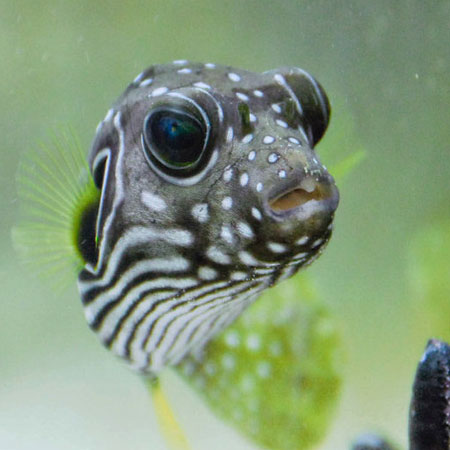
Stars and Stripes Puffer (Arothron hispidus)
What is its maximum size?
The Stars and Stripes Puffer can grow up to approximately 50–51 cm (20 inches) in the wild!
Where is its origin and where is it exported from?
The Stars and Stripes Puffer originates from tropical marine waters across the Indo-Pacific, including the Red Sea, East Africa, Southeast Asia, northern Australia, Japan and the Pacific Islands. It also occurs in parts of the tropical eastern Pacific. Specimens entering the aquarium trade may be exported from countries such as Indonesia, the Philippines and Kenya, depending on collection and supply sources.
Is it reef compatible?
No, the Stars and Stripes Puffer is not reef safe. It feeds on a wide range of invertebrates and may eat or damage corals, ornamental shrimp, crabs, snails, clams, starfish and other reef inhabitants. It is best suited to a large fish-only marine aquarium or a fish-only-with-live-rock (FOWLR) setup.
What should I feed it?
Feed a varied diet of meaty marine foods, including chopped squid, mussels, clams, shrimp, krill and other suitable crustaceans. Offer hard-shelled foods, such as shell-on shrimp and appropriately sized molluscs, regularly to help wear down its continuously growing teeth. Feed appropriate portions and remove uneaten food promptly to maintain water quality.
How many can I keep?
The Stars and Stripes Puffer is best kept singly in most home aquariums. It can become territorial, particularly as it grows, and keeping multiple large puffers together can lead to aggression and competition. A single specimen is generally the safest choice unless an exceptionally large aquarium and careful management are available.
How compatible is it with other fish?
This species can coexist with robust, similarly sized marine fish, provided the aquarium is sufficiently spacious. Potential tank mates may include larger wrasses, tangs and some triggerfish, depending on individual temperament and compatibility. Avoid very small fish, timid species and fish with long, delicate fins, as they may be harassed or eaten. Monitor all tank mates carefully, as individual behaviour varies.
Water parameters
- Temperature: 24–27°C
- pH: 8.1–8.4
- Specific gravity (salinity): 1.023–1.026
- Ammonia and nitrite: 0 ppm
- Nitrate: Keep as low as practical through efficient filtration and regular water changes.
- Filtration: Strong biological and mechanical filtration, with a suitably sized protein skimmer, is recommended.
Maintain stable water conditions and provide good oxygenation. As this species grows large and produces considerable waste, consistent aquarium maintenance is essential.