
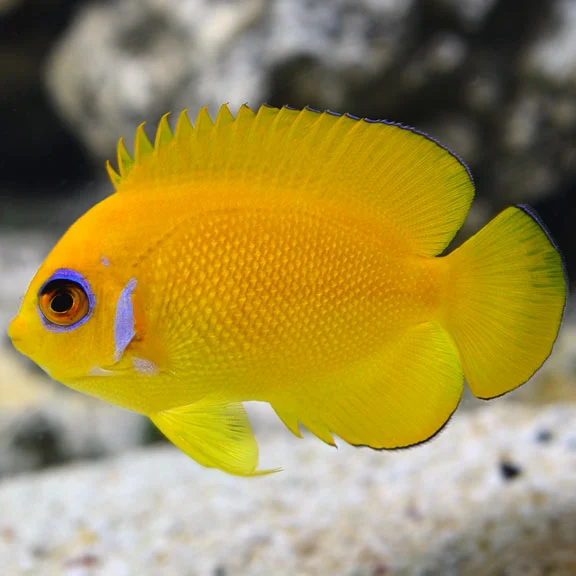
Lemon peel Dwarf Angel ( 7 days for delivery )
Earns 399 Aqua Points, worth £3.99 off a future order. How points work
- Arrive alive guarantee
- Overnight, oxygen packed
- You pick the day
Livestock delivery, done properly
- Overnight insulated delivery on fish orders, £19.95, and free collection near Gatwick
- Arrive-alive promise plus our Perfect Health Arrival guarantee
- You choose the delivery day at checkout. We only show days we can genuinely deliver
- £35 minimum on livestock orders. Dry goods ship free alongside fish
Marine Fish Perfect Health Promise
All marine fish have a Perfect Health Arrival guarantee. For the following reasons, we cannot guarantee beyond that.
A number of different reasons can affect why a marine fish does not settle into its new environment. These range from:
- Unsuitable water conditions: incorrect pH, high ammonia and nitrite levels.
- Tank bullies: some marine fish are very passive and will not mix well with more boisterous tank mates.
- Incorrect tank size: please research the fish you are buying, as some will become stressed in a tank that is too small.
If you have any problems on arrival
Please contact us straight away and we will extend your guarantee until the fish is healthy again. You must call on the arrival day to activate this.
01293 749046Credit notes
If any of your aquatic life dies during our guarantees and has been acclimatised in a mature aquarium, please take a photo and email it across and we will send you a credit note.
Please email photographs of the deceased specimens to sales@aquaticstoyourdoor.co.uk.
About this fish
What is its maximum size?The Lemonpeel Angelfish can grow to approximately 14 cm (5.5 inches) in length, making it one of the larger species of dwarf angelfish commonly kept in marine aquariums.
It is an active swimmer and requires a well-established aquarium with plenty of mature live rock, hiding places and open swimming space. A mature aquarium with abundant natural algae growth is particularly beneficial, as this species spends much of its day grazing.
Where is its origin and where is it exported from?The Lemonpeel Angelfish originates from the tropical Indo-Pacific region, with a distribution extending from southern Japan and the western Pacific through to the Great Barrier Reef, Fiji, the Marshall Islands and the Tuamotu Archipelago. It is also found around Christmas Island and parts of the eastern Indian Ocean.
It is commonly exported for the aquarium trade from countries and island regions such as Indonesia, the Philippines, Fiji and other Indo-Pacific locations.
Is it reef compatible?Generally considered reef compatible with caution, although the Lemonpeel Angelfish is one of the more notorious dwarf angelfish for coral nipping.
It is particularly known for picking at LPS corals, soft corals, zoanthids and clam mantles. Some individuals may also nip at SPS corals. Although certain specimens can be maintained successfully in reef aquariums, others can cause considerable damage to corals.
Its behaviour varies between individual fish, and even well-fed specimens may develop a taste for corals. It is therefore important to monitor it carefully after introduction. A fish-only aquarium or a reef aquarium without particularly delicate corals may be a safer option.
What should I feed it?Feed a varied diet consisting primarily of marine algae, spirulina, nori seaweed and high-quality marine angelfish preparations. Enriched frozen foods such as mysis shrimp, brine shrimp and other suitable marine preparations can also be offered.
Foods containing sponge material are beneficial as part of a varied diet. The Lemonpeel Angelfish is a natural grazer, so providing mature live rock with plenty of naturally occurring algae is particularly important.
Offer small portions several times throughout the day to support its health, colouration and natural grazing behaviour. A consistent supply of vegetable-based foods is especially important for maintaining its long-term condition.
How many can I keep?Best kept singly in most home aquariums. The Lemonpeel Angelfish can be particularly territorial, especially towards other dwarf angelfish and fish with similar body shapes or colouration.
In the wild, this species can form small harems consisting of one dominant male and several females. However, replicating this behaviour in a home aquarium requires a considerably larger system with plenty of swimming space and separate territories.
Keeping multiple individuals may be possible in very large aquariums, particularly when introduced together, but it is not generally recommended for the average home aquarium. Avoid mixing it with other Centropyge species unless you have considerable space and experience managing aggression.
How compatible is it with other fish?The Lemonpeel Angelfish can be compatible with a wide range of community marine fish, although it can become quite territorial once established.
Suitable tankmates include tangs, clownfish, wrasses, gobies, blennies, anthias, butterflyfish and other compatible marine species.
Care should be taken when introducing other yellow-coloured fish or species with similar body shapes, as the Lemonpeel may perceive them as competition. It can also become aggressive towards other dwarf angelfish.
Avoid keeping it with particularly timid or easily intimidated fish that may struggle to compete for food or cope with territorial behaviour.
Provide plenty of live rock, caves and hiding places to help reduce aggression and establish separate territories.
Water parametersTemperature: 24–28°C
pH: 8.1–8.4
Specific gravity: 1.023–1.026
Ammonia: 0 ppm
Nitrite: 0 ppm
Nitrate: Keep as low as practical with stable water quality.
Alkalinity: 8–12 dKH
If it does not arrive alive, you do not pay for it.
Photograph the bag unopened, send it to us within four hours of delivery, and we will put it right with a refund or a replacement.* Our guarantee on marine fish covers their health on arrival. If anything concerns you, please ring us on the day they arrive and we will extend it until the fish is healthy again.
*Whether we refund or replace is our decision and depends on the fish and its cost. A replacement may travel with a future order rather than straight away.