
Vagabond Butterfly (7 days for Delivery)
Earns 161 Aqua Points, worth £1.61 off a future order. How points work
- Arrive alive guarantee
- Overnight, oxygen packed
- You pick the day
Livestock delivery, done properly
- Overnight insulated delivery on fish orders, £19.95, and free collection near Gatwick
- Arrive-alive promise plus our Perfect Health Arrival guarantee
- You choose the delivery day at checkout. We only show days we can genuinely deliver
- £35 minimum on livestock orders. Dry goods ship free alongside fish
Marine Fish Perfect Health Promise
All marine fish have a Perfect Health Arrival guarantee. For the following reasons, we cannot guarantee beyond that.
A number of different reasons can affect why a marine fish does not settle into its new environment. These range from:
- Unsuitable water conditions: incorrect pH, high ammonia and nitrite levels.
- Tank bullies: some marine fish are very passive and will not mix well with more boisterous tank mates.
- Incorrect tank size: please research the fish you are buying, as some will become stressed in a tank that is too small.
If you have any problems on arrival
Please contact us straight away and we will extend your guarantee until the fish is healthy again. You must call on the arrival day to activate this.
01293 749046Credit notes
If any of your aquatic life dies during our guarantees and has been acclimatised in a mature aquarium, please take a photo and email it across and we will send you a credit note.
Please email photographs of the deceased specimens to sales@aquaticstoyourdoor.co.uk.
About this fish
What is its maximum size?
Typically grows to approximately 18–20 cm in length, although larger specimens can reach around 23 cm.
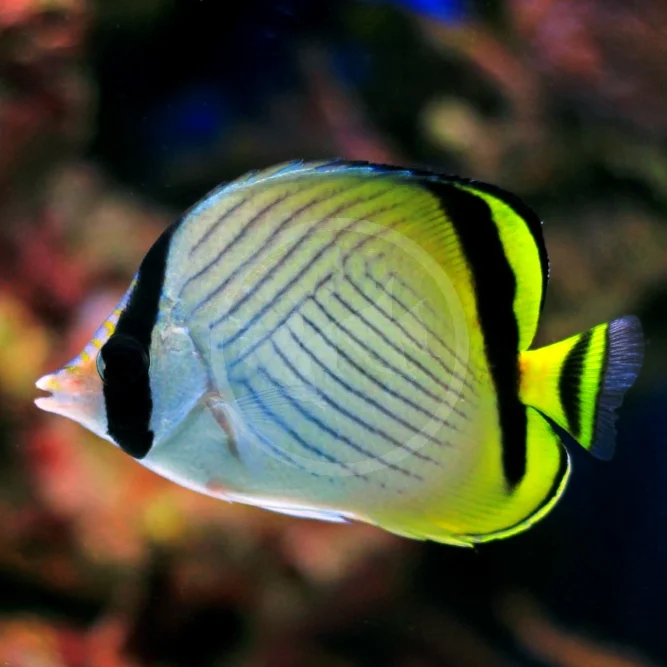
It has an attractive white or silvery body covered in fine dark diagonal lines, a distinctive black band through the eye and contrasting yellow and black markings towards the rear of the body.
Where is its origin and where is it exported from?
The Vagabond Butterflyfish, also known as the Criss-cross Butterflyfish, is found throughout the Indo-Pacific, with a natural distribution extending from East Africa and the Red Sea region across Indonesia, the Philippines and the Great Barrier Reef, north towards southern Japan and east into the Pacific islands.
It inhabits coral reefs, lagoons, reef flats and coastal reef environments, generally at depths of 1–30 metres.
It is commonly exported for the aquarium trade from countries such as Indonesia, the Philippines and other Indo-Pacific collection regions.
Is it reef compatible?
Not reef safeThe Vagabond Butterflyfish is not considered reef safe. In the wild, it feeds on coral polyps, anemones, worms, crustaceans and algae.
In an aquarium, it may nip at and consume:
Hard and soft coral polyps.
Zoanthids.
Feather duster worms.
Small ornamental invertebrates.
Anemones and other sessile reef inhabitants.
It is best suited to fish-only marine aquariums or fish-only-with-live-rock (FOWLR) systems rather than established coral reefs.
What should I feed it?
Vagabond Butterflyfish are omnivorous and require a varied diet containing both meaty and vegetable-based foods.
Suitable foods include:
Frozen mysis shrimp.
Enriched brine shrimp.
Finely chopped prawns and seafood.
Chopped mussels and clams.
Marine fish pellets and flakes.
Spirulina-based foods and marine algae.
Specialist butterflyfish preparations.
Feed small portions two to three times daily, particularly while the fish is settling into a new aquarium. Newly introduced specimens may initially prefer live or frozen foods before accepting prepared alternatives.
How many can I keep?
Vagabond Butterflyfish are generally best kept singly or as a compatible male and female pair.
Adults are frequently observed swimming in pairs in the wild, often defending a shared feeding territory.
Keeping multiple individuals together can lead to territorial aggression, particularly in smaller aquariums. If keeping a pair, introducing both fish together is recommended.
A minimum aquarium size of approximately 475 litres is recommended, with larger aquariums preferable for adult specimens.
How compatible is it with other fish?
Generally peaceful towards most unrelated marine fish, although it can become territorial towards other butterflyfish, particularly similar-looking species.
Suitable tankmates include:
Tangs and surgeonfish.
Angelfish.
Clownfish.
Larger peaceful wrasses.
Rabbitfish.
Other suitably sized community marine fish.
Avoid keeping them with highly aggressive fish that may prevent them from feeding properly.
Water parameters
Temperature: 24–27°C
pH: 8.1–8.4
Specific gravity (salinity): 1.023–1.026
Ammonia and nitrite: 0 ppm
Nitrate: Keep as low as practical through good filtration and regular water changes.
Alkalinity: Maintain approximately 8–12 dKH for stable marine conditions
If it does not arrive alive, you do not pay for it.
Photograph the bag unopened, send it to us within four hours of delivery, and we will put it right with a refund or a replacement.* Our guarantee on marine fish covers their health on arrival. If anything concerns you, please ring us on the day they arrive and we will extend it until the fish is healthy again.
*Whether we refund or replace is our decision and depends on the fish and its cost. A replacement may travel with a future order rather than straight away.