
Snowflake Eel (7 days for Delivery)
Earns 187 Aqua Points, worth £1.87 off a future order. How points work
- Arrive alive guarantee
- Overnight, oxygen packed
- You pick the day
Livestock delivery, done properly
- Overnight insulated delivery on fish orders, £19.95, and free collection near Gatwick
- Arrive-alive promise plus our Perfect Health Arrival guarantee
- You choose the delivery day at checkout. We only show days we can genuinely deliver
- £35 minimum on livestock orders. Dry goods ship free alongside fish
Marine Fish Perfect Health Promise
All marine fish have a Perfect Health Arrival guarantee. For the following reasons, we cannot guarantee beyond that.
A number of different reasons can affect why a marine fish does not settle into its new environment. These range from:
- Unsuitable water conditions: incorrect pH, high ammonia and nitrite levels.
- Tank bullies: some marine fish are very passive and will not mix well with more boisterous tank mates.
- Incorrect tank size: please research the fish you are buying, as some will become stressed in a tank that is too small.
If you have any problems on arrival
Please contact us straight away and we will extend your guarantee until the fish is healthy again. You must call on the arrival day to activate this.
01293 749046Credit notes
If any of your aquatic life dies during our guarantees and has been acclimatised in a mature aquarium, please take a photo and email it across and we will send you a credit note.
Please email photographs of the deceased specimens to sales@aquaticstoyourdoor.co.uk.
About this fish
What is its maximum size?
Typically grows to approximately 60–75 cm in length in captivity, although larger specimens can reach around 100 cm in the wild.
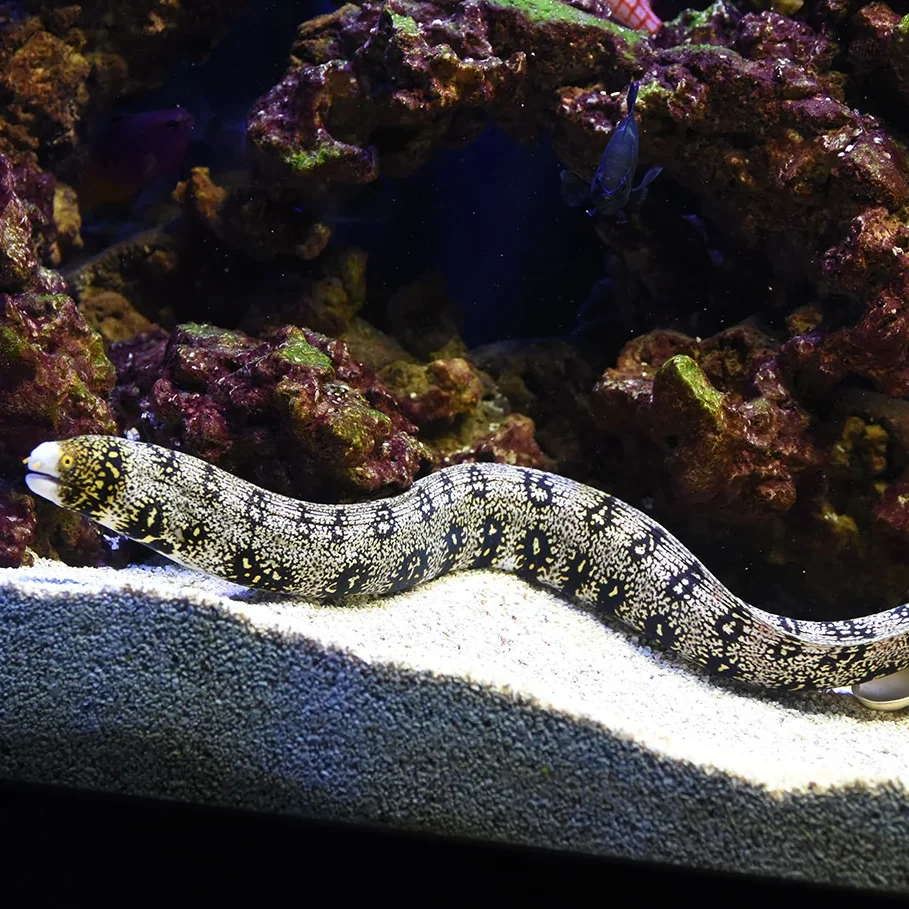
It has a distinctive cream-white body covered with black and yellow markings resembling snowflakes, giving it its common name.
Where is its origin and where is it exported from?
Snowflake Moray Eels are native to the Indo-Pacific region, with a natural distribution extending from the Red Sea and East African coast through Indonesia, the Philippines and Australia to southern Japan and Hawaii.
They inhabit shallow coral reefs, lagoons and rocky reef environments, where they spend much of the day hiding inside rock crevices.
They are commonly exported for the aquarium trade from countries including Indonesia, the Philippines and Sri Lanka.
Is it reef compatible?
Reef compatible with caution. Snowflake Moray Eels generally leave corals alone and do not deliberately feed on coral polyps.
However, they are natural predators of crustaceans and other small invertebrates. Ornamental shrimp, crabs, hermit crabs and snails are therefore at risk.
They may also disturb loose rockwork and unsecured corals while moving around the aquarium.
They are best suited to fish-only aquariums or carefully planned reef aquariums without vulnerable invertebrates.
What should I feed it?
Snowflake Moray Eels are carnivorous and naturally feed on crustaceans and other meaty prey.
Suitable foods include:
Frozen prawns and shrimp.
Mysis shrimp.
Chopped squid.
Mussels and cockles.
Krill.
Chopped marine fish.
Other suitable marine seafood.
Feed adults approximately two to three times per week, adjusting portions according to the eel's size and body condition. Younger specimens may require more frequent feeding.
Use long feeding tongs to offer food safely. Never hand-feed, as accidental bites can cause serious injuries.
How many can I keep?
Snowflake Moray Eels are generally kept singly.
However, multiple specimens can sometimes be housed together in sufficiently large aquariums, provided there are plenty of hiding places and adequate space.
Introducing compatible individuals at the same time is preferable, as established eels may become territorial towards newcomers.
How compatible is it with other fish?
Generally peaceful towards fish that are too large to be considered potential prey, although it remains a predator and can become particularly active during feeding.
Suitable tankmates may include:
Tangs.
Larger angelfish.
Larger wrasses.
Triggerfish.
Rabbitfish.
Groupers.
Avoid keeping them with very small fish, ornamental shrimp, crabs and other small invertebrates.
Care should also be taken when feeding alongside other predatory fish, as competition can become intense.
Water parameters
Temperature: 24–27°C
pH: 8.1–8.4
Specific gravity (salinity): 1.023–1.025
Ammonia: 0 ppm
Nitrite: 0 ppm
Nitrate: Keep as low as practical through good filtration and regular water changes.
Alkalinity: 8–12 dKH
Calcium: 380–450 ppm
Magnesium: 1250–1350 ppm
If it does not arrive alive, you do not pay for it.
Photograph the bag unopened, send it to us within four hours of delivery, and we will put it right with a refund or a replacement.* Our guarantee on marine fish covers their health on arrival. If anything concerns you, please ring us on the day they arrive and we will extend it until the fish is healthy again.
*Whether we refund or replace is our decision and depends on the fish and its cost. A replacement may travel with a future order rather than straight away.